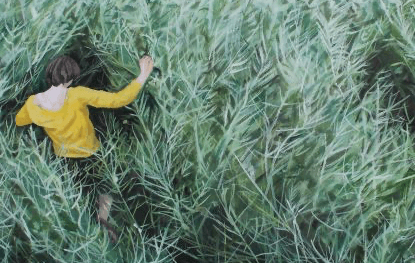
The Factory, Hiroko Oyamada
everyday-systems
/
The novel weaves together the perspectives of three characters employed in an enormous factory — an organization so vast and complex that it begins to resemble an autonomous world governed by its own laws. They perform tasks whose purpose no one can clearly explain, while the factory itself seems to exist entirely for its own sake.
The factory is more than a workplace. It organizes the workers’ time, space and consciousness. The characters understand the meaning of their duties less and less, while their identities dissolve into impersonal procedures.
People work, follow instructions and disappear into the rhythm of the organization, while their inner lives and individual desires are almost entirely erased. The factory remains in motion, but that motion no longer leads toward any purpose beyond sustaining itself.

THE ONTOLOGY OF NATURE
In such a world, animals become something the system cannot fully subordinate — they begin to function as a crack in the factory’s rational order.
Birds, moss and kuro — these strange creatures, difficult to classify with any certainty — begin to seem more real than the people. They have rhythm, bodies, behaviours, cycles, environments. They are described with greater attention than the characters themselves. The narrative pauses over their anatomy, movement, reproduction and presence in space.
The birds are particularly interesting because they constantly cross the boundaries imposed by the factory. They move freely between inside and outside, ignoring divisions that matter to humans. They represent a nonhuman perspective — a world that exists alongside corporate logic without submitting to its rules. Nature penetrates the factory from within, emerging through its cracks and gradually dissolving the boundaries between the human, the animal and the organizational. It signals that the world cannot be completely enclosed within human categories of work, utility and control.
The factory may have regulations, departments, passes, tasks and an internal hierarchy, but beside the birds, moss and kuro it begins to look like an artificial order without roots. It is monstrously precise, but ultimately dead and without any reason to exist.
The more we learn about the animals, the more striking the emptiness of the humans becomes. A question emerges: who is actually alive here?
NON-LINEAR TIME
Time in this novel behaves much like space in dreams. It is not entirely chaotic, but it slips free of ordinary chronology.
In the classical novel, time is tied to the development of the character. In Proust, Mann or Murakami, the passage of time means a transformation of consciousness. In Oyamada, the characters barely develop at all. Without any clear inner transformation, time loses its traditional meaning.
The shifting perspectives produce the same effect. When we see the same event through several people, we do not receive a fuller picture, as we might in a classical realist novel. Instead, we become less certain which version of reality is the right one. Scenes break off abruptly and jump between locations, intensifying this impression: one moment we are watching the accounting department, another the study of moss, then the animals, then someone’s apartment. As if the camera belonged not to a human being, but to the factory itself.
The human being ceases to determine the rhythm of the story. The rhythm begins to belong to the factory, and time itself becomes subordinated to the logic of the organization rather than the logic of human experience.
THE EXISTENTIALISM OF PROSPERITY
While reading Oyamada, I kept returning to associations with Franz Kafka’s The Trial and The Castle, Dino Buzzati’s The Tartar Steppe, and Kōbō Abe’s The Woman in the Dunes. These are books about a person thrown into a reality whose rules they do not understand and cannot control.
In classical existential literature, the absurdity of the world does not release the individual from the burden of decision; on the contrary, it leaves them alone with the necessity of choosing and defining themselves within that world. In Oyamada, this anxiety has been neutralized. The corporate system relieves the individual of the obligation to search for meaning, offering instead a safe, institutional form of anaesthesia.
Her reality is remarkably comfortable. The factory feeds you, pays on time, provides housing and guarantees stability. The system takes away your identity, but offers security in return. The exchange proves surprisingly attractive. The characters do not seem like people who are trapped. Quite the opposite. They gradually merge with the logic of the factory and begin to experience their existence as something that starts and ends with the magnetic card that opens the factory gate.
The book is short, but difficult to move through. The plot does not carry you forward, the characters do not draw you in, and the factory itself reveals nothing. We do not even know what it produces.
The book draws you in not through story, but through a kind of dissolution that feels disturbingly familiar. The human being ceases to occupy the centre, and it is precisely this shift that I find most interesting. I do not read it as an absence. Rather, as a quiet posthumanist crack in the novel: the human does not disappear, but loses its privileged position. It becomes one element within an arrangement subordinated to a system that functions despite possessing no ontological clarity whatsoever.
This is not an entirely alien world. And that is precisely the problem.
The book was awarded the Mishima Prize in 2013.