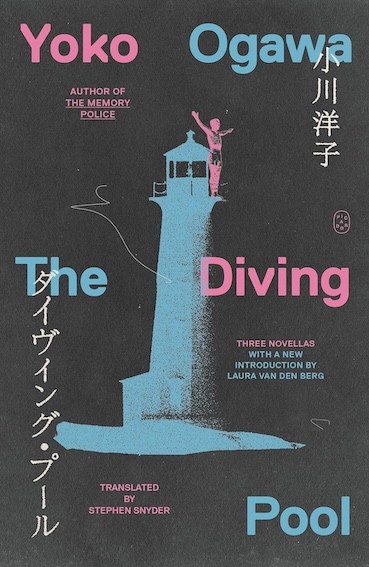
The Diving Pool: Three Novellas, Yoko Ogawa
dark-margins
/
Aya lives with her parents in the Christian orphanage they run, called the House of Light. Many children live there, having arrived after the death of their parents, abandonment, or removal from families affected by violence and addiction.
The girl falls in love with Jun, who grows up beside her, becoming physically mature as their former childhood closeness turns into desire. Aya regularly and secretly comes to the swimming pool to watch his training from hiding, fascinated by his body, his discipline and the precision of his movements.
At the same time, Aya torments little Rie, the youngest girl in the orphanage, leaving her with a sense of abandonment, helplessness and fear.
THE POOL
Jun stands motionless at the end of the diving board. His feet grip the rough surface, his calves are tense, his arms raised high. Everything converges into a single, clean line.
The movement begins in the feet, passes through the knees, hips and back. In the air, the body changes shape: the back arches, the arms close in, the knees draw up toward the chest. For a fraction of a second, the figure hangs vertically between the ceiling and the water.
The hands enter first. The water parts narrowly, closes around the arms, head, torso and legs, and the figure disappears without a trace. Only a brief opening in the surface remains, widening circles and bright bubbles descending into the depths.
A moment later, Jun surfaces. Wet hair clings to his forehead, drops run down his neck and shoulders. The dive is over, but for a moment the skin and muscles still remember its shape.
In the House of Light, he is one of many quiet children. At the pool, he regains his own form and, for a few seconds, belongs entirely to himself.
Aya sits hidden in the stands and watches him train. She is fascinated by Jun’s body: focused, controlled, enclosed within a perfect movement between the diving board and the surface of the pool. Time moves completely differently here than it does at home. In the stands, Aya can suspend her life for a moment and become nothing but a gaze.
At home, Aya’s identity dissolves completely — there is no distinct place or boundary separating her from the other children. Jun’s body has exactly what she lacks: coherence, direction and a boundary. Perhaps, then, she desires not so much Jun himself as the state of existence he reaches in the air.
The pool creates a closed, isolated world governed by the repetitive ritual of diving. Aya can only watch it, commit it to memory and wait for the next repetition. That is why her desire never fades — the object of fascination keeps revealing itself and slipping away.
The humidity gives this place physicality. The air clings to the skin, enters the lungs, settles on objects. Aya does not merely see Jun — she breathes the same dense atmosphere, feels the temperature of the pool and its smell. In this way, she participates in his physicality without touching him. The pool is therefore more than a setting. It is an apparatus of desire — a space that extracts the body from everyday life and gives it a pure, almost abstract form.
Ogawa disperses eroticism throughout the entire environment. Desire passes from the body into the water, the air, the light, the tiles, the echo and the smell. The pool becomes at once an extension of Jun’s body and Aya’s inner world.
Rie
Ogawa does not directly explain the source of Aya’s cruelty. Her violence can, however, be read as an attempt to carve out a position of her own in a home where the biological bond with her parents has been dispersed among all the children. Although Aya is constantly surrounded by her peers, she lives in profound isolation. Her parents’ noble mission has its price: it deprives the girl of exclusive attention and erodes her sense of rootedness.
Violence restores boundaries where the home has blurred them. Rie becomes the site on which Aya reconstructs the lost difference between herself and others. Since her family does not give her a unique position, she establishes one herself — through power over the weakest child.
Her fascination with Jun and her tormenting of Rie grow out of the same need to exist as someone distinct. At the pool, Aya secretly watches someone who is able, for a few seconds, to escape the orphanage and reclaim his own body. At home, she compensates for this by turning on the weakest child, because only Rie’s fear gives her a sense of agency. These are two different impulses born from the same need: to stop being a transparent part of the House of Light and give herself a distinct shape.
The Diving Pool was nominated for the Akutagawa Prize in 1989/90.