After Dark, Haruki Murakami
city-of-signs
/
The action of the book "After Dark" takes place in Tokyo during a single night, roughly from dusk to dawn. "After dark" signifies both the narrative time and a state of the world in which ordinary social roles lose their sharpness, and people appear more as nocturnal functions, transitions, and semi-presences than as persons.
After Dark is also the title of a piece of music, specifically—Five Spot After Dark by Curtis Fuller.
Takahashi, a trombone-playing boy, tells Mari in Denny's restaurant that it was this very track from the album Blues-ette that made him choose the trombone as his instrument, or rather, the trombone chose him.
The jazz form carries over into the composition of the novel: brief entrances, shifts in perspective, recurring motifs, the nocturnal rhythm of the city, pauses, scenes like improvised phrases. The book does not tell a plot—it plays it like jazz.

NOCTURNAL MONTAGE
Nocturnal Tokyo consists of separate, loosely connected frames: Mari sitting in a twenty-four-hour restaurant, Eri locked in a room and trapped in sleep, Takahashi moving between conversation and music, Kaoru protecting the nightly circulation of a love hotel, Shirakawa shifting through an office, a screen, an elevator, and the empty night. People are shown here fragmentarily—by place, gesture, light, or a temporary arrest in space. This optics replicates the actual experience of the city. We see people, we pass them, we enter their story for a few minutes, but the urban person remains present only as a fragment of an image, a signal, a surface, and a behavior.
SECTION
The camera allows us to see Tokyo as an observed and studied organism: all elements react to one another, but they do not form a healthy whole. The city functions, conducts impulses, produces images, work, violence, and contact, yet it does not transform these connections into a meaningful life. The system works, but it does not integrate its parts. People touch, talk, and react to one another, but they remain fragments of a larger system that manages them rather than allowing them a real encounter.
Each character reveals a different dysfunction of this tissue: sleep without life, work without the human, a body without security, conversation without permanence, movement without purpose. Eri has a body but is cut off from action. Shirakawa operates efficiently, but in a state of total emotional detachment. Mari observes, listens, and moves, but still keeps the world at a distance. Takahashi moves solely within the zone of nocturnal temporariness.
The incident in the love hotel proves that violence is not an anomaly here—it has been written into the city's nocturnal infrastructure. There is a room, a procedure, cleanup, staff reaction, a telephone, the body of the injured woman, and a man who effortlessly vanishes back into his daytime life. The violence is immediately serviced by the system. The city does not stop because of it; it absorbs it and works on.
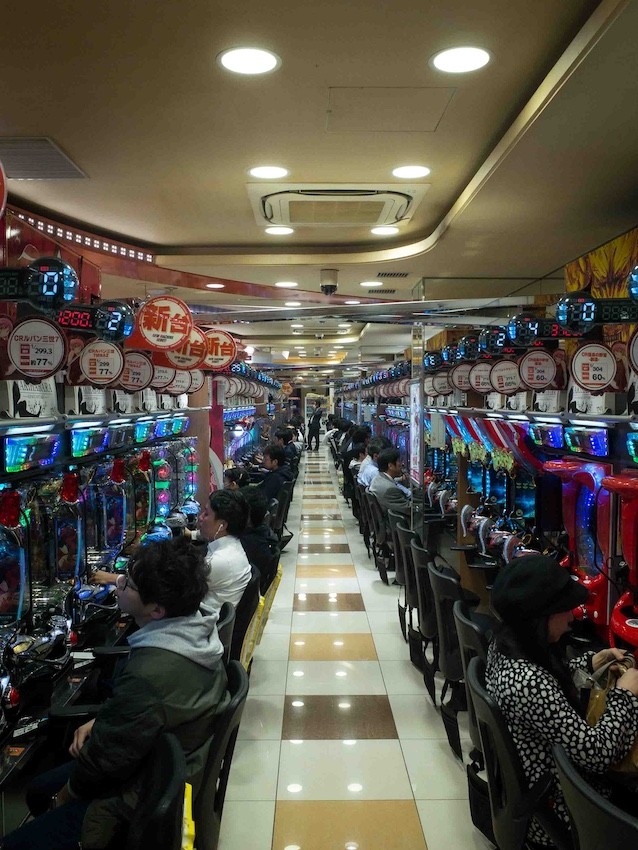
Pachinko
DARIUSZ PROLEJKO / Tokyo, Japan/
The modern city is not the background of life, but a mechanism that divides the human being into functions, images, gestures, and impulses, and then connects these fragments in a purely technical and accidental manner.
"After Dark" thus becomes an inquiry into what remains of a human being when we look at them solely as an element of a network. Murakami's answer is cool: what remains is a silhouette, a voice, a body, a gesture, a place, a screen, and a rhythm. Only from these scattered elements can one attempt to reassemble a human being.
It is not a lack of relationships that is the problem, but the morbid form of connection.
