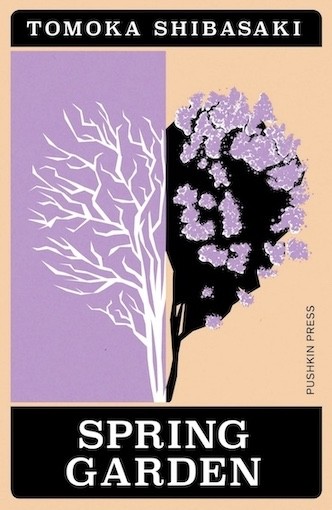
Spring Garden, Tomoki Shibasaki
city-of-signs
/
VIEW PALACE SAEKI III
Tarō is around thirty. After his divorce, he moves alone into View Palace Saeki III, an apartment block in Tokyo scheduled for demolition. His lease is still valid, so he remains one of the few residents left. He does not look for a new apartment or plan a new life. He waits until moving becomes unavoidable.
Tarō does not know his neighbours’ names, so he refers to them by the zodiac signs assigned to their apartments: “Mrs Snake,” “Dragon Woman.” People exist as elements within a spatial arrangement: someone lives one floor above, someone next door, someone has just moved out.
After his father’s death and cremation, Tarō grinds the remains in a kitchen mortar, preparing the ashes to be scattered. The gesture was meant to complete the ritual of farewell, but fragments of bone become lodged in the grooves of the mortar. Tarō cannot bring himself to wash it or throw it away. In its indentations, the last physical trace of his father remains.
THE BLUE HOUSE
Nishi lives in the same apartment block as Tarō. Several years earlier, she happened to buy a photography book called Spring Garden, showing the interiors and residents of the blue house across the street.
The blue house is not an ordinary building. It is an individually designed space with a garden, custom-made furnishings and carefully arranged interiors. The book presents not only the architecture, but also the lives of people connected with the arts who shaped the space around their own way of living.
Since then, she has regularly returned to the area to look at the house from outside. Over time, observation alone is no longer enough. She wants to see what remains of a place she has known for years only through photographs.
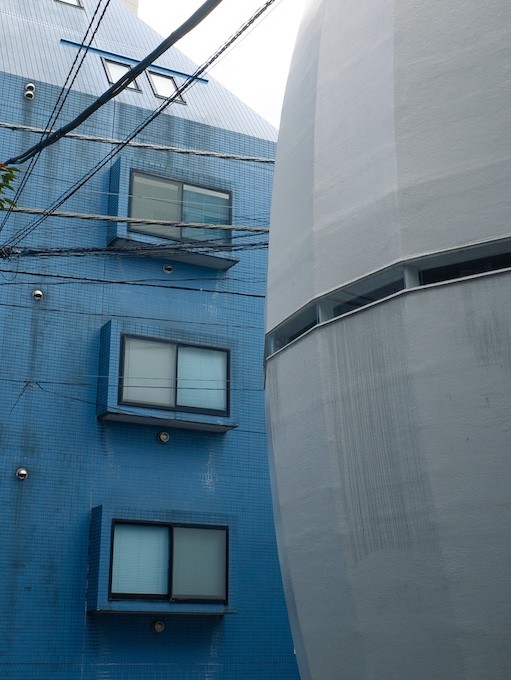
Natural Ellipse (ナチュラル・エリップス)
DARIUSZ PROLEJKO / Shibuya, Tokyo, Japan/
ARCHITECTURE AND SPACE
In Spring Garden, architecture organizes the lives of the characters more powerfully than their relationships do. Tarō lives in a building scheduled for demolition — from the beginning, he occupies a space with no future. Residents disappear, apartments empty one after another, and the building becomes a material record of dissolution.
Tarō occupies space, but does not inhabit it. His apartment serves for survival, the neighbourhood for movement, his neighbours remain points of orientation. The place never becomes a home.
In fact, Tarō begins to resemble the building he lives in: his marriage has collapsed, his father has died, his relationships have faded, and the future has been suspended. Tarō exists in a state before demolition. He still goes to work and performs the gestures of everyday life, but the structure that once organized his life is already gone.
Nishi grew up in apartment blocks, so space is associated for her with repetition and anonymity. Her current apartment is purely functional — a place for sleeping, eating and storing things, but it says nothing about her.
For Nishi, the blue house is first and foremost an image. She encounters it first in the pages of a photography book and only later finds it within the fabric of the city. From the beginning, it exists for her somewhere between a physical place and a myth. What fascinates her is the life embodied in that space — a world coherent, individual and consciously shaped, in opposition to the ordinariness in which she grew up.
The city is not a neutral background here, but a system that continually erases the traces of previous lives. The demolition of the apartment block is more than a transformation of space — it becomes an image of the modern metropolis, where human life is absorbed into a cycle of use, emptying and replacement. People inhabit places, but rarely have time to make them their own; architecture survives only for as long as it remains economically useful.
Tarō remains inside a building that is gradually disappearing from the city map. Nishi looks toward a place she has never inhabited. He lives in a space without a future; she in a space that exists primarily as an image.
Buildings preserve lives that are already gone, and lives that never happened.
The novel was awarded the prestigious Akutagawa Prize in 2014.