Snakes and Earrings, Hitomi Kanehara
unstable-self
/
Lui is nineteen years old. She lives in Tokyo and is in a relationship with Ama—a young man whose body is covered in tattoos, his tongue split in two. From the outset, their bond is defined by a fascination with extremity, pain, and physical modification.
Lui longs to have a dragon entwined with a kirin—a mythical creature with deer antlers, scales, and a chimeric form—tattooed on her back. But before ink meets skin, she wants to fulfill her ultimate desire: to split her tongue in two.
Lui's story is measured out by successive weights placed in the aperture of her tongue: from 14G to 0G*, from the initial piercing to the moment her tongue takes on the shape of a serpent’s—just like Ama’s.
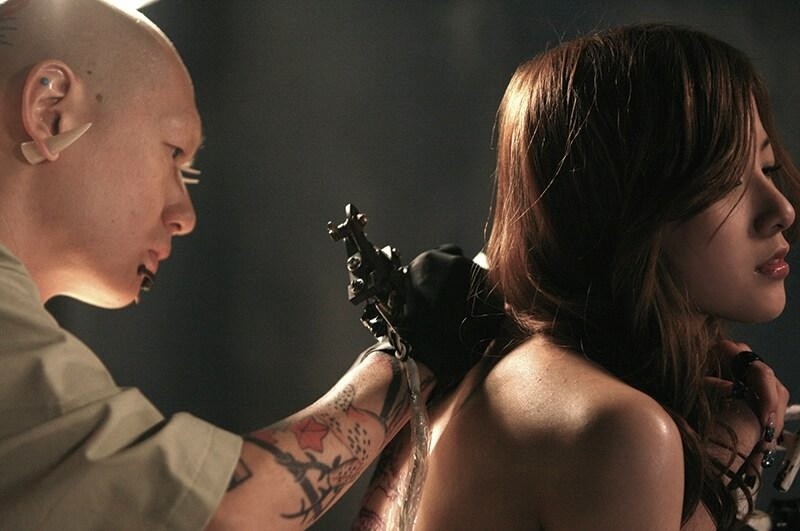
Snakes and Earrings / Hebi ni piasu (蛇にピアス).
Directed by YUKIO NINAGAWA, 2008.
In Japan, Snakes and Earrings quickly became a phenomenon. The Akutagawa Prize, Kanehara's youth, and sales exceeding one million copies propelled the book far beyond the literary sphere. The media eagerly highlighted its most sensational elements—sex, violence, piercing, and tattoos—framing the novel as an emblem of generational transgression and youth rebellion.
What interested me more was the movement in the opposite direction. Beneath the layer of provocation and media frenzy lies a far more fundamental question: why does Lui alter her body?
THE BODY AS MATERIAL
Lui does not act as though the body has some preexisting, natural form that must be accepted. It is material. It can be pierced, tattooed, stretched, severed. The body begins to be observed, touched, designed, altered. It acquires a form, a history, and meaning.
Lui does not attempt to discover a "true self" hidden beneath the surface. She creates herself through altering the body. She disrupts its inherited form and bestows her own upon it. Only then does the body truly become hers. Modification operates here like a signature left on something that, from that moment on, belongs solely to her.
A sense of self-worth grounded in what comes from the outside proves brittle and impermanent: people leave, relationships dissolve, emotions shift. What could offer support turns out to be unreliable. Ink in tissue remains. Thus, she seeks permanence in the body—in marks inscribed upon it indelibly. She brings identity out from within, directly to the surface.
Only from this perspective do piercings, tattoos, and a split tongue cease to be tokens of belonging, fashion, or subcultural rebellion. They become instruments of self-creation—a way of conferring upon one’s own body a chosen form, one that no one can strip away and that persists when people, relationships, and emotions prove mutable.
The book won the Akutagawa Prize for the second half of 2003, awarded in January 2004.
Snakes and Earrings was adapted into a film in 2008 as Snakes and Earrings / Hebi ni piasu (蛇にピアス), directed by Yukio Ninagawa.
* (G) - Gauge is a scale used to measure the thickness of body piercing jewelry. The lower the number, the greater the diameter of the jewelry and the piercing canal.

